
Bottle Packing Machine for End-of-Line Beverage Packaging
Shrink wrapping, carton packing and conveyor matching for bottled water, drinks, oil, sauce and daily chemical products.
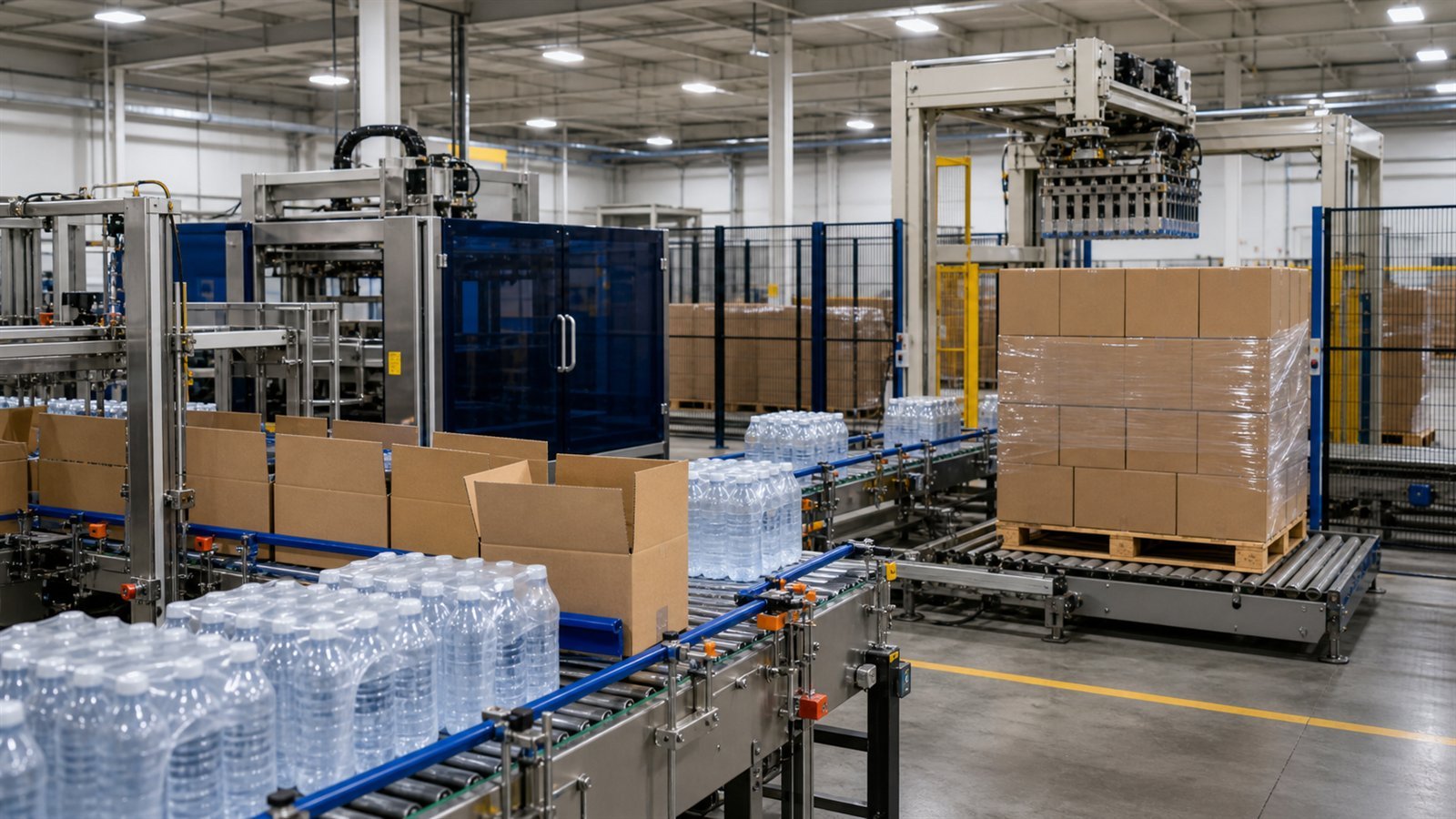
Configuration points before quotation
| Pack format | Shrink pack, tray pack, carton, handle pack or palletizing. |
|---|---|
| Bottle size | Container dimensions, pack count, film/carton material and output speed. |
| Integration | Conveyors, date coding, inspection, weighing and warehouse flow. |
Practical selection support before quotation
Estimate machine scope by capacity, bottle size, filling technology and packaging level.
Check water, air, power, floor space, conveyors and future expansion.
Match filling, capping, labeling, coding, packing and treatment modules.
Use photos, videos, drawings and checklists before production and shipment.
Confirm contact material, electrical standard, packing method and test videos.
Coordinate export packing, documents, shipping method and destination needs.
Prepare manuals, wiring, commissioning points and remote communication.
Keep spare-parts logic and troubleshooting contact available after delivery.
Send these details for a useful recommendation
| Product | Water, juice, tea, carbonated drink, oil, sauce, detergent, cosmetics, dairy or other liquid. |
|---|---|
| Container | PET bottle, glass bottle, jar, can, HDPE bottle, gallon bottle; size, neck, cap and label type. |
| Capacity | Bottles per hour, filling volume, number of SKUs and expected shift time. |
| Line Scope | Only filling machine, or treatment, blowing, capping, labeling, coding, packing and conveyors together. |
| Destination | Country, voltage, shipping preference and installation support needs. |
Send product, bottle and capacity details
Allot Tech (Suzhou) Co., Ltd. was founded in 2019. We honestly combine new-media communication and China manufacturing export sourcing so global buyers can find practical equipment options.
Email: sales@allottech.com
USA: +1 818 262 0958
China: +86 186 6213 1120
One-Stop Beverage Equipment Solutions | We Ship Worldwide from China
Buyer decision brief
Select bottle packing equipment from distribution requirements
The right pack protects filled containers through storage and transport while matching local material supply and retail expectations. Begin with bottle geometry, bundle or case count, pallet plan and shipping route, then select shrink, tray, carton and pallet automation.
Selection matrix
Decisions to resolve before supplier comparison
| Decision area | Define in the RFQ | Why it changes the equipment |
|---|---|---|
| Unsupported shrink bundle | Film-only grouping for compatible rigid bottles. | Verify film strength, tunnel profile, carry points and bundle stability. |
| Tray plus shrink film | Adds a base for heavier or less stable bottle groups. | Confirm tray board, loading pattern, film seal and cooling conveyor. |
| Wraparound or regular carton | Provides protection and printable shipping surfaces. | Match board grade, glue or tape, partitions, loading and case compression. |
| Palletized load | Combines cases or bundles into a warehouse unit. | Define pallet, layer pattern, pads, stretch wrap, height and load stability. |
Quotation inputs
Information to send
- Filled bottle dimensions, weight and cap or handle projection.
- Units per bundle or carton and required row arrangement.
- Film, tray, carton, adhesive and pallet specifications.
- Target packs per minute and upstream accumulation conditions.
- Distribution distance, stacking, climate and manual handling rules.
- Format range, changeover target and warehouse interface.
Acceptance evidence
What to verify
- Use sale-intent bottles and production packaging materials.
- Check count, orientation, film seal, carton closure and appearance.
- Perform agreed lift, compression, vibration or transport trials.
- Verify guarding, jam access, material refill and safe restart.
- Run the packer and pallet interface at integrated line speed.
Buyer questions
Questions to settle before an order
What is the difference between shrink and carton packing?
Shrink packing groups bottles with film, optionally over a tray. Carton packing encloses them in board for protection and printing. Product weight, distribution and retailer requirements should guide the choice.
How is a bottle packer matched to line speed?
Convert bottle output into packs per minute using the exact pack count, then allow for material loading, changeovers, short stops and recovery. Verify the complete line rather than one nameplate rate.
Do I need a tray under the shrink pack?
That depends on bottle stability, bundle weight, film properties, handling and transport. Trial packs should be lifted, stacked and moved through the intended distribution route.
What materials should be sent for a packing test?
Provide filled production bottles, caps, printed or representative film, trays or cartons, adhesive where relevant, pallet details and the required finished-pack sample or drawing.
Bottle packing machine buyer answers
Choose a bottle packing machine by pack pattern, material and downstream rate
A bottle packing machine turns capped and often labeled containers into the retail or shipping unit. Shrink wrapping, tray packing, carton packing and case handling each place different demands on bottle spacing, film or board, pack count, code location, accumulation and palletizing. This guide starts from the finished pack and works backward to a stable, serviceable end-of-line system.
Buyer workflow
Design the packing system around the finished unit
The right packer protects the product, sustains the filling-line rate and can be changed over without hidden material or control problems.
Freeze the finished pack
State bottle or can count, pattern, film, tray, carton, handle, code, pallet and distribution requirements.
Check container behavior
Confirm cap, label, moisture, temperature, shape, filled weight, center of gravity and scuff sensitivity at the packer inlet.
Calculate the pack rate
Convert good containers per minute into bundles, cases and pallets, then allow for replenishment, rejects, stops and changeovers.
Choose the pack principle
Compare shrink, tray, wraparound carton, case loading or manual-assisted options by protection, materials, labor, flexibility and cost.
Plan accumulation and inspection
Define buffer zones, missing-bottle detection, pack count, code checks, reject handling and restart behavior.
Prove the real materials
Run approved film, tray, carton, labels and pallets at the agreed speed and inspect pack strength after cooling and handling.
Direct answers
Bottle packing machine questions buyers ask before a line purchase
These answers focus on the evidence a buyer can request before approving a configuration, quotation or shipment.
What does a bottle packing machine do?
It groups filled containers into a defined retail or shipping configuration and may wrap, tray, load into cartons, seal, code and transfer the finished packs. The exact boundary varies. Some projects include only a shrink wrapper, while others include bottle collation, pack inspection, case packing, palletizing and stretch wrapping. Write the start and end point so “packing machine” does not hide missing equipment.
Should I use shrink wrap, tray packing or cartons?
Shrink film can provide product visibility and compact multipacks; trays can add support; cartons can offer protection, printing area and stacking strength. The decision depends on bottle shape, closure, pack count, film or board supply, transport, warehouse handling, retailer requirements and local packaging cost. Test the actual pack through cooling, accumulation and handling before choosing from a catalogue photo.
How do I calculate the required packing machine speed?
Start with sustained good containers per minute from the filling line, then divide by bottles per bundle or case. Add allowance for material replenishment, format change, short stops, rejects and the output of the slowest downstream stage. State the bottle size and pack pattern with every speed figure. A packer that only matches a theoretical filler maximum may create a bottleneck in normal production.
Can one packing machine handle different bottle sizes and pack patterns?
Many packers can run an agreed format range with different guides, collation settings, film, cutting, tunnel, carton tooling or recipes. Large differences in diameter, height, cap, label or filled weight may reduce speed or need dedicated change parts. List every format, bundle count and material before ordering. Request a complete parts list and timed changeover demonstration.
What bottle condition matters before packing?
The packer needs stable spacing and a container that can tolerate guides, grouping and film or carton handling. Wet or cold bottles can affect labels, film shrink, glue and code readability. Lightweight containers may tip or deform under accumulation pressure. Define cap, label, moisture, temperature, filled weight and surface condition at the packer, then test the least stable format.
How should a shrink tunnel be specified?
Film type and thickness, pack pattern, bottle material, line speed, tunnel length, heating, airflow, cooling and pack appearance all interact. The machine should achieve a secure bundle without damaging bottles, labels or closures. Define shrink, seam, wrinkles, opening, film consumption and cooling acceptance. Run the actual film and pack format rather than accepting a test with a convenient substitute.
What should a carton packing line prove?
Confirm carton style, board grade, dimensions, partitions, adhesive or tape, bottle count, loading method, closure, code and transport stability. Test carton forming, bottle loading, sealing, reject behavior and recovery after stops. Case capacity should be stated as good sealed cases per hour. A carton erector alone is not evidence that the complete loading and sealing system will run.
How do packing machines connect to the filler, labeler and palletizer?
Define conveyor height, pitch, accumulation, handoff speed, sensors, controls, communication, stop and restart logic. Upstream products may be capped and labeled or may arrive with different spacing. Downstream palletizing needs a stable case or bundle rate and pattern. Use an interface drawing and responsibility matrix so each supplier knows who provides the conveyor, sensor, guard, signal and accumulation zone.
What inspection functions should a bottle packing machine include?
Depending on risk, the system may check bottle presence, cap, label, code, bundle count, film, carton closure or pallet pattern. Define the defect, detection threshold, reject action and record. Challenge missing bottles, wrong counts, poor codes and damaged packs at production speed. Confirm that the reject is physically separated and that a failed reject generates a safe stop or alarm.
What changes the price of a bottle packing machine from China?
Price varies with pack principle, rate, pack pattern, bottle range, collation, film or carton material, tunnel, glue or tape, coding, inspection, conveyors, accumulation, change parts, controls, palletizing, documentation, export packing and installation. Compare the same scope and material. Ask for options separately and identify consumables and local work so an apparently low price does not omit the critical pack stage.
Buyer inputs
Send a finished-pack specification
- Bottle or can dimensions, weight and surface condition.
- Cap, label, code and finished-product requirements.
- Bundle, tray, carton and pallet patterns.
- Film, board, adhesive, tape and material tolerances.
- Good containers per hour and format schedule.
- Distribution, warehouse and handling conditions.
- Layout, utilities, inspection and installation needs.
Supplier response
Require end-of-line proof
- Rate calculation from bottles to finished pallets.
- Pack-method rationale and material operating window.
- Conveyor, accumulation and stop-restart logic.
- Format parts, recipes and timed changeover.
- Inspection, reject and fault-challenge matrix.
- Production-material FAT and pack-quality limits.
- Utilities, spares, documents and service scope.
Transparent sourcing
Connect Chinese packing equipment to the whole beverage line
Allot Tech (Suzhou) Co., Ltd. was established in 2019. With a background in new media and online communication, we began combining digital communication with machinery sourcing and export coordination in 2025. We help buyers make the finished-pack scope and test evidence clear when coordinating with Chinese partners; the final performance should be accepted on the buyer’s actual bottles and packaging materials.
Continue your research
Related equipment and procurement guides
Use the next page that matches your product route, package, machine type or purchasing stage.
End-of-line packaging
Specify the finished pack before selecting the packing machine
Bottle stability, pack pattern and shipping conditions determine whether shrink film, tray, carton or pallet handling is suitable.
| Project area | Buyer input to confirm | Engineering output |
|---|---|---|
| Primary container | Bottle dimensions, weight, stability and production speed | Infeed lanes and accumulation requirement |
| Pack format | Bottle count, row pattern, film, tray or carton | Collation, wrapping or case-packing method |
| Logistics | Pallet pattern, warehouse handling and export conditions | Conveying, palletizing and stretch-wrapping scope |
What the recommendation should define
A balanced end-of-line scope showing pack drawing, nominal output, accumulation and the boundary between automatic and manual work.
Pack format decision
Choose a bottle packing machine for distribution, not only for line speed
Shrink-only bundles, tray-and-film packs and closed cartons protect and present bottles differently. The correct route depends on bottle rigidity, primary-label protection, pack handling, warehouse stacking, transport conditions, material supply and the acceptable changeover workload.Primary pack
Confirm bottle strength, cap height, label sensitivity and surface condition.
Secondary pack
Define count, orientation, tray or carton, openings and print requirements.
Distribution
Use warehouse, pallet and transport conditions to set the protection target.
| Packing route | Where it may fit | Main limitation to examine | What to prove at FAT |
|---|---|---|---|
| Shrink-only bundle | Stable containers and distribution routes where a lightweight grouped pack is acceptable | Lower structural protection and sensitivity to film, tunnel and bottle behavior | Bundle geometry, seals, cooling, handle openings, film use and pack stability |
| Tray plus shrink film | Packs needing a base for handling or better support than film alone | Additional board supply, forming and material-change requirements | Tray formation, bottle loading, film result and transfer through downstream equipment |
| Closed carton | Products needing stronger protection, stacking or printed secondary packaging | Board quality, sealing method, case dimensions and higher material scope | Case squareness, loading, flap sealing, coding, compression and pallet pattern |
| Drop or pick-and-place case packing | Defined bottle and case families where automated loading is justified | Container handling, gripping, partition needs and format complexity | Bottle damage rate, case loading pattern, recovery after interruption and format change |
Finished-pack data that prevents a generic packing quote
- Bottle drawing and filled weight, closure projection, label position and allowable surface marks.
- Pack count and orientation, tray or carton drawing, film or board specification and barcode location.
- Required good packs per minute, upstream bottle rate, accumulation allowance and pallet pattern.
- Changeover formats, planned campaign sequence, material tolerances and operator-access requirement.
- Acceptance samples and measurements for pack appearance, protection, seal quality, material use and restart performance.