5 gallon water filling line for barrel washing, filling, capping and packaged drinking water distribution, with practical export and after-sales support from China.
3-5 Gallon Water Filling Line
3 gallon and 5 gallon barrel water filling line for drinking water stations and distributors, including washing, filling and capping.
Barrel Water Washing Filling Capping System
The 3-5 gallon water filling line is used for returnable barrel drinking water production and can include washing, filling, capping and conveying.
Main Features
Barrel Washing
Multi-stage washing helps clean returnable barrels.
Automatic Filling
Designed for stable barrel filling and capping.
Water Plant Support
Can be matched with water treatment equipment.
Typical Line Configuration
| Application | 3 gallon and 5 gallon water production |
|---|---|
| Containers | Returnable water barrels |
| Capacity | Configured by barrels per hour |
| Optional Equipment | External brushing, cap remover, water treatment, conveyors |
What We Need to Quote
- Product type, bottle or container size, cap type and packaging format.
- Target output per hour and working shifts per day.
- Factory layout, voltage, compressed air and water source conditions.
- Whether you need a single machine or a complete turnkey beverage production line.
Need a 3-5 gallon water filling line?
Contact Allot Tech at sales@allottech.com, +1 818 262 0958 or +86 186 6213 1120 for a practical machine recommendation.
Practical Notes for 5 Gallon Water Filling Line Buyers
When comparing 5 gallon water filling line suppliers in China, the most reliable quotation starts from real production conditions, not only a machine name. Allot Tech checks product characteristics, package format, output target, utilities, layout and export requirements before recommending a beverage machinery solution.
Best-fit applications
This page is most relevant for barrel water plants and returnable bottle distribution. We can help compare machine configuration, matching upstream and downstream equipment, and the practical space needed for installation.
How we match equipment
We review barrel size, washing process, cap type and daily output. This helps avoid under-sized machines, unnecessary automation, missing conveyors, weak packaging plans or shipment problems after the order is placed.
Quote checklist
- Product and bottle or package size
- Target capacity per hour or per day
- Cap, label and packing style
- Factory layout, voltage and destination country
Common Questions About 5 Gallon Water Filling Line
How do I choose the right 5 gallon water filling line?
Start with the product, container size, target capacity, available utilities and factory space. Allot Tech uses these details to match the filling, packing and auxiliary equipment instead of recommending a machine only by price.
Can this 5 gallon water filling line be shipped worldwide from China?
Yes. We can coordinate packing, export documents and international shipment from China. Buyers can contact sales@allottech.com with destination country and project requirements.
What information is needed for a quotation?
Please send product type, bottle or container drawings, output target, cap or label style, factory layout if available and any preferred automation level.
Start with bottle condition and washing requirements
A 3-5 gallon line is different from a small PET bottle line because returnable bottles may arrive with variable contamination, wear and residual labels. The washer, inspection points, filling enclosure, cap handling and finished-bottle conveying must be planned around the real bottle-return system.
| Project input | Equipment decision | Reason |
|---|---|---|
| Returnable or new bottles | Pre-inspection, brushing and washing-stage scope | Returned bottles need more contamination control than new single-use bottles |
| Bottle volume and neck | Grippers, guides, filling position and cap applicator | Large bottles require stable handling and compatible closures |
| Washing chemistry | Tank count, heating, dosing, contact time and drainage | Cleaning performance depends on soil level, detergent and rinse sequence |
| Target bottles per hour | Linear machine size, conveyor speed and operator stations | Inspection and manual tasks can limit practical output |
| Finished-bottle handling | Leak check, light inspection, bagging and conveyor layout | Heavy filled bottles need controlled transfer and ergonomic handling |
Large-bottle water projects
Design washing and inspection around the real bottle-return system
Returnable large bottles need a different hygiene and handling plan from new small PET bottles. Bottle condition and return logistics influence the washer and inspection scope.
| Project area | Buyer input to confirm | Engineering output |
|---|---|---|
| Bottle condition | New or returnable, contamination, handle and wear limits | Incoming inspection and rejection rules |
| Washing program | Prewash, detergent, internal wash, rinse and drain | Stage count, chemistry, temperature and contact time |
| Filling and dispatch | Volume, cap, target bottles per hour and rack or bag | Filler, capper, leak check and finished-bottle handling |
What the recommendation should define
A hygienic flow from incoming bottle inspection through washing, filling, capping, leak checks and finished-bottle dispatch.
Large-bottle water line buyer center
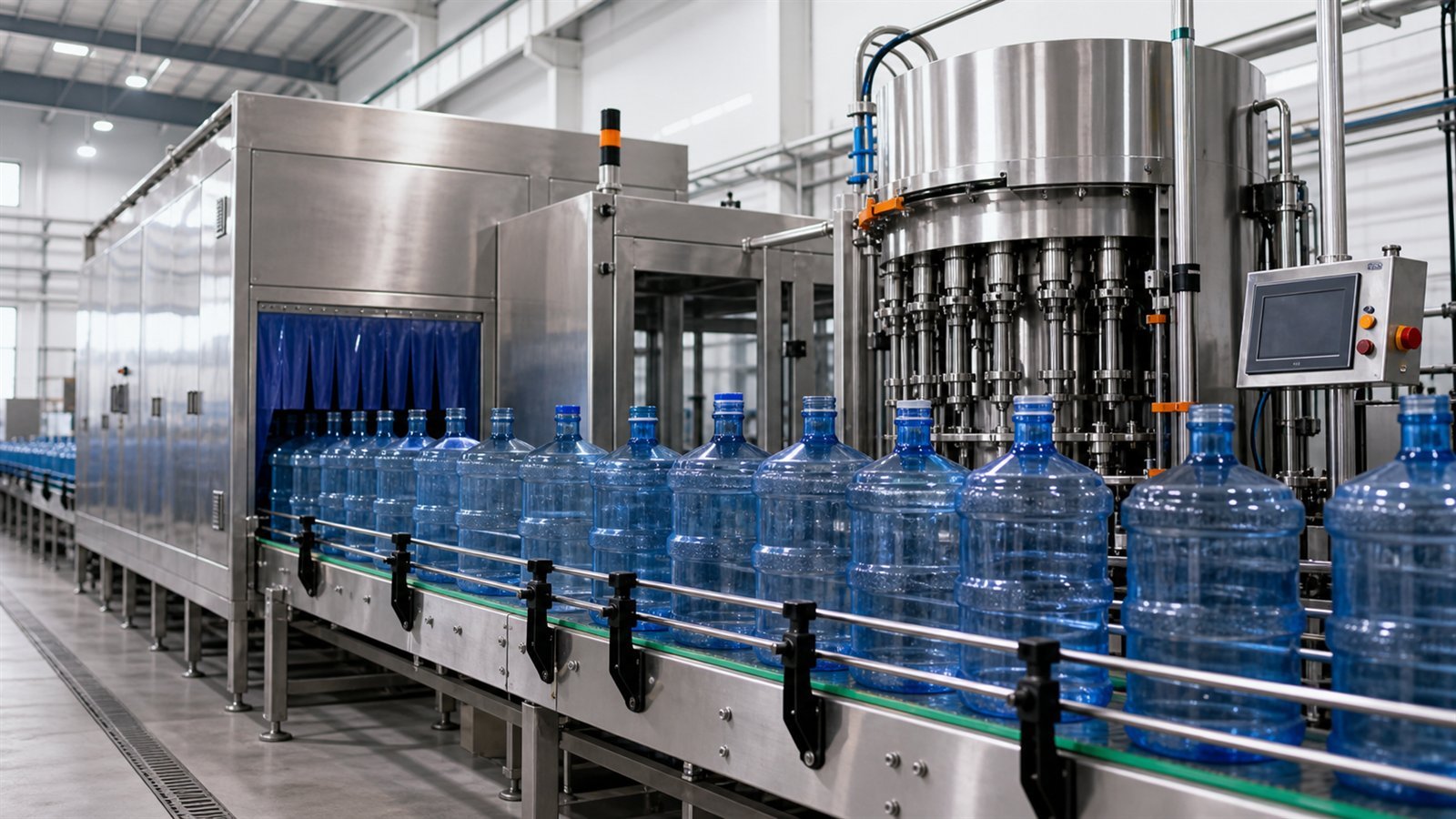
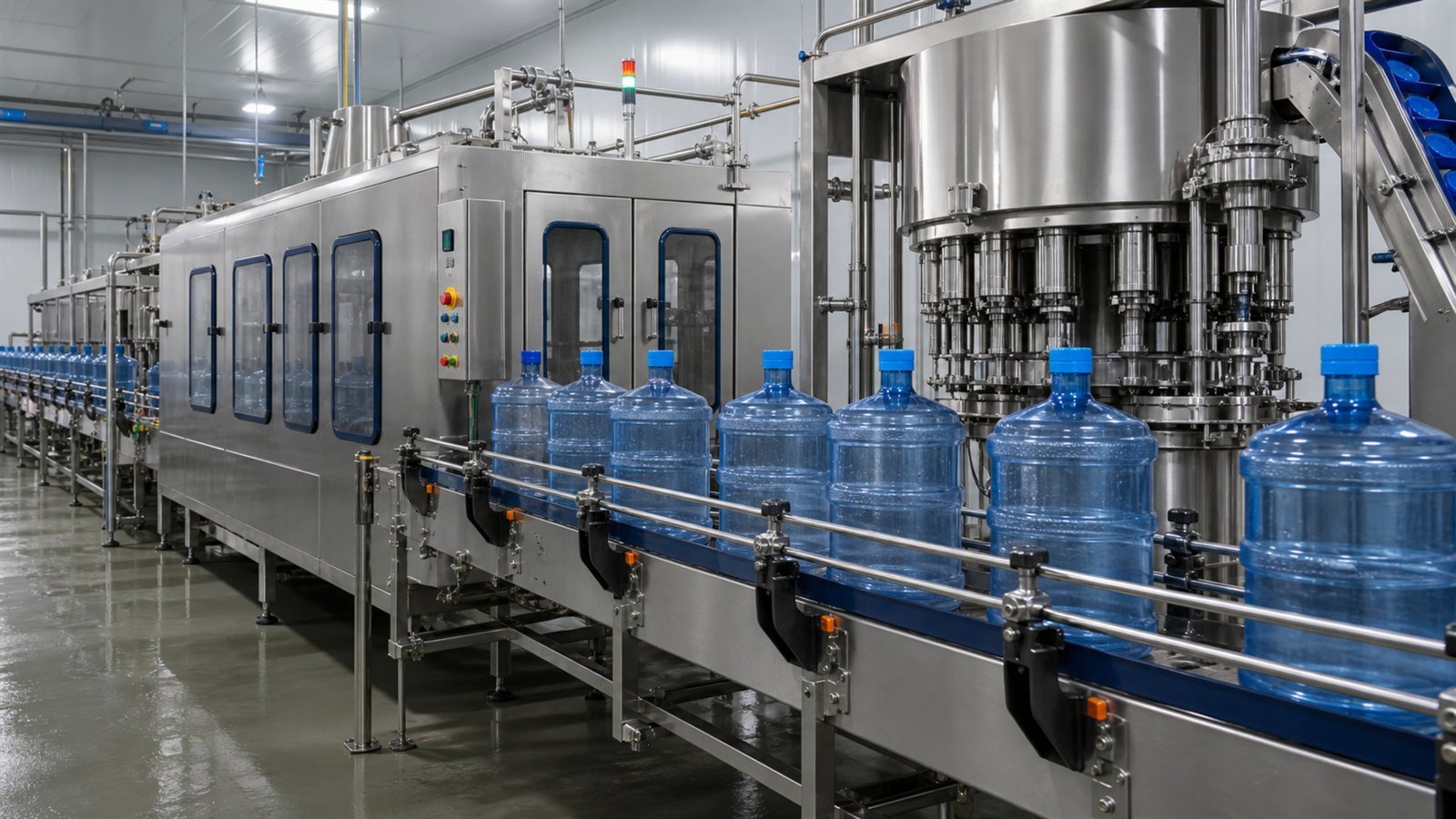
Choose a 3-5 gallon water filling line by bottle return, hygiene and daily output
A five-gallon line is not a scaled-up small-bottle filler. Returnable bottle condition, exterior and interior washing, disinfection, clean-side handling, cap hygiene and route-delivery logistics determine the practical equipment scope. Use the capacity bands below as RFQ starting points, then require the supplier to confirm performance with representative returned bottles and an agreed test method.
Search intent to project data
Common 5-gallon line capacity searches and what they really mean
The same BPH label can describe very different washing programs, bottle conditions and automation boundaries. These are planning bands, not performance guarantees. Confirm bottle volume, representative return condition, wash chemistry, clean-water demand and the sustained acceptance test before comparing prices.
| Capacity or scope | Typical planning context | What the RFQ should clarify |
|---|---|---|
| 120 BPH | Compact regional or start-up plant | Manual or assisted bottle inspection, lower-speed multi-stage washer, filler and capper; prioritize dirty-to-clean separation and drainage. |
| 300 BPH | Growing route-delivery operation | More automatic bottle transfer, controlled washing stages, cap handling and finished-bottle inspection with labor planned around returns. |
| 600 BPH | Established multi-route water business | Balanced washer, filler, capper and conveying with sufficient treated-water, chemical dosing, utilities and finished-goods handling. |
| 900-1200 BPH | Higher-volume centralized plant | Automatic bottle feeding, washing, filling, capping, leak checks and bagging or rack handling; line efficiency and return-bottle variation need explicit FAT conditions. |
Buyer specification
Equipment scope from returned bottle to dispatch
Use each item as a written quotation checkpoint. Ask suppliers to mark included, optional, excluded or buyer-supplied and attach the evidence that will confirm the final choice.
Incoming bottle control
Define accepted bottle sizes, handle types, label residue, odor, damage and rejection criteria before washing.
External and internal washing
Specify prewash, detergent or disinfectant stages, contact conditions, jet coverage, final rinse and drainage time.
Treated-water interface
Match water treatment, hygienic storage and distribution to filling plus final-rinse peak demand.
Filling and capping
Confirm fill volume, cap specification, cap treatment, application method, leakage checks and no-bottle controls.
Clean-side handling
Separate dirty returns from washed bottles, caps, filling and finished product to reduce recontamination risk.
Finished-bottle logistics
Define coding, protective bagging, handle application, racks, warehouse flow and delivery-vehicle loading.
From search to specification
A practical decision sequence for a returnable-bottle water project
Use this sequence before asking for a final 3-gallon or 5-gallon water line price. It keeps hygiene risk, output and building requirements connected to the commercial comparison.
- 01
Audit real returned bottles
Collect representative bottles from the planned route, including scratched, labeled, odorous and deformed examples. Record bottle and handle dimensions, cap type, rejection rules and expected daily return volume. This evidence determines washing coverage, inspection labor, conveyor handling and the samples required for a meaningful factory acceptance test.
- 02
Define the hygiene route
Map dirty reception, pre-inspection, external washing, internal washing, chemical stages, final rinse, clean filling, capping and finished-bottle dispatch. State water quality, chemistry, contact conditions and drainage assumptions. Suppliers can then explain the washer design against an explicit sanitation objective instead of quoting a stage count without context.
- 03
Balance output and utilities
Convert saleable daily demand into a capacity range using scheduled hours, sanitation time, return-bottle rejects and realistic operating efficiency. Check treated-water peak flow, storage, power, compressed air, heating, chemical dosing and drainage at the same output basis. An undersized utility system can limit a correctly selected filler.
- 04
Write the acceptance plan
Define the approved bottles and caps, test duration, measured output point, wash and fill checks, leakage criteria, alarms, records and handling of open actions. Ask each bidder to identify exclusions, consumables, spares, export packing, installation and training so the final comparison reflects installed project scope rather than one machine price.
Direct buyer answers
Questions buyers search before requesting a quotation
These answers define the next project decision without presenting an early estimate as final engineering or a contractual guarantee.
How much does a 5-gallon water filling line from China cost?
Price depends on capacity, washing stages, bottle-return condition, automation, water treatment, cap handling, inspection, bagging, export packing and service scope. Send the same bottle samples, target BPH and washing requirement to each supplier before comparing totals.
What capacity should a new 5-gallon water plant choose?
Start from daily route demand, scheduled hours, return-bottle inventory, sanitation time and realistic line efficiency. A 300 BPH machine running one shift does not automatically produce 2,400 saleable bottles because washing, stops, rejects and changeovers reduce output.
Can one machine run both 3-gallon and 5-gallon bottles?
It may be possible when the bottle neck, height, diameter, handle and cap system fit the designed range, but change parts and washing coverage must be confirmed from drawings and samples.
How many washing stages are required?
There is no universal stage count. The approved hygiene plan should reflect bottle reuse, contamination, local water-safety requirements, chemistry, temperature, contact time and final-rinse quality.
Should returned bottles be tested during FAT?
Yes. New bottles do not represent scratches, label residue, odor, deformation and contamination found in real returns. Agree representative samples, rejection rules and a documented test sequence.
Is water treatment included in a gallon filling line?
Not always. Ask the quotation to mark water treatment, tanks, pumps, hygienic piping and final-rinse supply as included, optional or buyer-supplied.
What utilities should be confirmed?
Confirm treated-water flow, raw-water conditions, electrical supply, compressed air, heating or steam where used, chemical dosing, drainage, ventilation and floor loading.
What should be sent for a useful quotation?
Send bottle and cap drawings or samples, return-bottle photos, target BPH and daily output, washing policy, water analysis, factory layout, utilities, destination and required installation support.
Continue the decision path
Related equipment, capacity and procurement guides
Open the route that matches the real product, package, capacity or purchasing stage.