
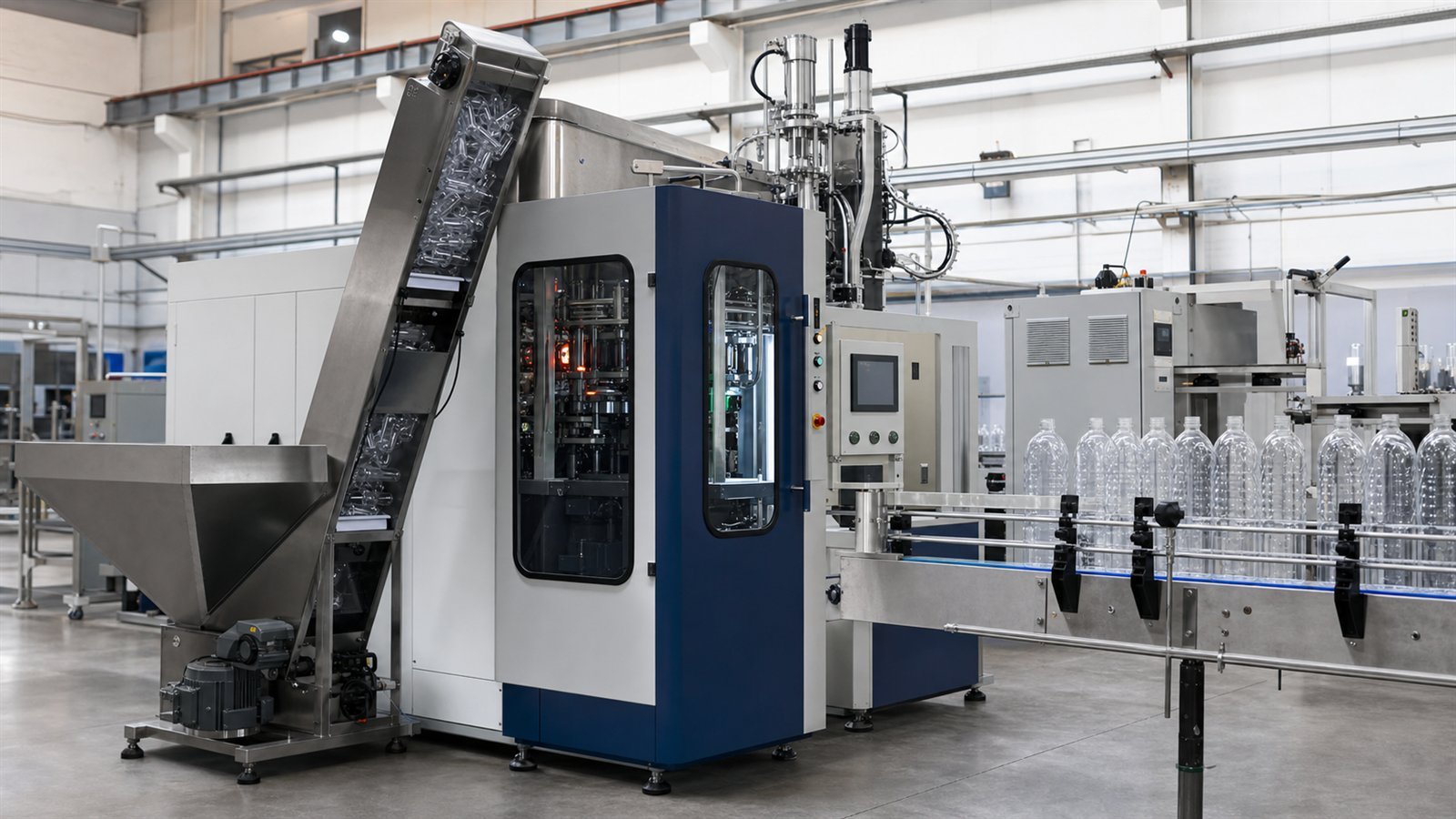
Bottle Manufacturing
Standalone Blower vs Blow-Fill-Cap Combiblock
A standalone blower gives flexible layout and buffer options, while a blow-fill-cap combiblock removes air conveying and can reduce bottle handling. The decision depends on output, lightweighting, format range, hygiene, footprint, redundancy and service strategy.
Practical buyer guide | Updated August 27, 2026 | Final scope must be verified through drawings, samples and agreed acceptance tests
Editorial basis
Planning guidance, not a final machine specification
Published by Allot Tech (Suzhou) Co., Ltd. This multilingual library uses a consistent buyer-decision framework and independently prepared language packs. Confirm the final configuration against supplier drawings, actual product and packaging samples, destination requirements and the signed technical agreement.
Direct answer
What this decision means for a real filling project
A standalone blower gives flexible layout and buffer options, while a blow-fill-cap combiblock removes air conveying and can reduce bottle handling. The decision depends on output, lightweighting, format range, hygiene, footprint, redundancy and service strategy.
This guide is part of the PET Bottle Blowing and Preform Engineering cluster. Read the hub when the project still needs a broader comparison.
Engineering inputs
Define the duty before comparing equipment
A useful proposal starts from agreed process and package information. These inputs keep suppliers from filling gaps with incompatible assumptions.
Send these details
- Target output and formats
- Available floor space
- Bottle weight target
- Hygiene class
- Maintenance and redundancy plan
Require these checks
- Compare complete line scope
- Review changeover access
- Model stop and restart behavior
- Verify utilities and specialist support
Line integration
Connect the choice to upstream and downstream equipment
Project decision record
Turn the topic into four controlled project decisions
A useful guide should change the RFQ, proposal and acceptance plan. Use this record to keep the buyer, equipment supplier and site team on the same basis.
Freeze the application basis
Record target output and formats together with available floor space. Attach drawings, photos and representative samples when dimensions or product behavior affect the design.
Define rated and sustained duty
State bottle weight target and hygiene class. Separate nameplate rate from the sustained result expected with normal stops, changeovers and quality checks.
Control line interfaces
Mark every interface as supplier scope, buyer scope or third-party scope before the order is released.
Approve measurable evidence
Agree how to verify compare complete line scope and review changeover access. The test plan should identify samples, duration, instruments, pass criteria and closure evidence.
Comparison sheet
Put every supplier on the same basis
| Decision area | What to state in the RFQ | What to verify |
|---|---|---|
| Product | target output and formats | compare complete line scope |
| Package | available floor space | review changeover access |
| Performance | bottle weight target | model stop and restart behavior |
| Operation | hygiene class | verify utilities and specialist support |
| Project scope | Utilities, interfaces, documents, spares, packing, shipping and support | Written inclusions, exclusions and acceptance evidence |
Verification route
Move from a claim to recorded evidence
- Approve the duty, drawings and test conditions before fabrication is treated as final.
- Use production-intent product and packaging wherever they materially affect performance.
- Record results by format, operating condition and quality criterion rather than relying on a short edited video.
- List open items, owners and closure evidence before packing and again after site commissioning.
Risk register
Resolve these risks before price becomes the deciding factor
Low quotations often hide different assumptions. A short written risk register makes technical and commercial differences visible before contract award.
| Risk | Why it matters here | Required control |
|---|---|---|
| Application mismatch | Combiblock integration is not automatically the lowest-risk choice for every capacity, package mix or maintenance team. | Confirm target output and formats and test compare complete line scope. |
| Package or format mismatch | Unapproved containers, closures, labels or tolerances can invalidate an otherwise suitable machine choice. | Freeze available floor space and verify review changeover access with production-intent samples. |
| Line imbalance | A filler cannot deliver saleable output when feeding, closing, labeling, packing or utilities become the constraint. | State bottle weight target and verify model stop and restart behavior across the connected line. |
| Weak acceptance evidence | Put verify utilities and specialist support into the FAT and SAT plan, including owners and close-out evidence. |
Buyer questions
Answers to common RFQ and acceptance questions
When is Standalone Blower vs Blow-Fill-Cap Combiblock useful?
Buyers comparing conventional PET line architecture with integrated blow-fill-cap equipment. Combiblock integration is not automatically the lowest-risk choice for every capacity, package mix or maintenance team.
What details should be supplied before requesting a quotation?
Prepare the following project-specific information: target output and formats, available floor space, bottle weight target, hygiene class, maintenance and redundancy plan. Drawings, photos and representative samples help the engineering review move from a budget assumption to a defined scope.
How should the proposed solution be checked before acceptance?
Use an agreed review or test plan to compare complete line scope, review changeover access, model stop and restart behavior, verify utilities and specialist support. Record the conditions, measurements and open actions so the result can be compared with the approved specification.
What should the supplier proposal state for standalone blower vs combiblock?
The proposal should state the design basis, included equipment, utilities, interfaces, output conditions, change parts, documentation, spare parts, delivery boundary and acceptance method. For this topic, explicitly record target output and formats and available floor space.
What evidence should be retained after FAT and site handover?
Retain the approved specification, drawings, test conditions, measured results, alarm and safety checks, open-item register, manuals, backups, parts list and signed handover record. This guide particularly requires evidence for compare complete line scope and review changeover access.
One-Stop Beverage Equipment Solutions
Send the liquid, bottle, output and destination
Allot Tech (Suzhou) Co., Ltd. was founded in 2019. Our roots are in new-media and online communication; since 2025, we have combined that experience with China manufacturing sourcing to introduce practical beverage and liquid-packaging equipment to global buyers honestly and clearly.